
ISO 45001
Certification in Occupational Health and Safety Management System
ASK FOR A QUOTATION See Requirements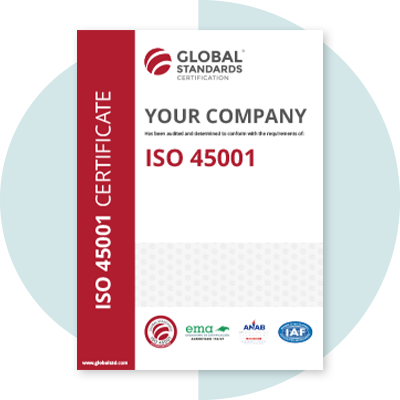
INTERNATIONAL RECOGNITION
Our certificates are accepted everywhere in the world
 |
 |
 |
 |
ISO 45001 CERTIFICATION
This international standard was published by ISO and focuses on work health and safety. It will replace OHSAS 18001.
ISO 45001 provides a framework to improve safety, reduce risks in the workplace, and improve the health and wellbeing of the employees, allowing organizations to actively optimize their work safety and health indicators.
It is applicable to all organizations, regardless of the size, industry branch, or nature of their operations. It has been designed to be integrated with other ISO management systems, as it has a High-Level Structure (HLS), which is also part of the ISO 9001 and ISO 140001 Standards.
Public and private organizations are being encouraged to demonstrate their commitment towards social responsibility, a requirement shared with the Social Responsibility group that manages ISO 26000, formed by representatives of the industry, government, workers, consumers, NGOs, etc.
ADDITIONAL REQUIEREMENTS
These are obligatory requirements to show evidence of compliance with the management system ISO 45001. These are established from the following sections of the standard:
4.-Organization contexts
5.-Leadership
6.-Planning
7.-Support
8.-Operations
9.-Performance evaluation
10.-Improvement
ADDITIONAL REQUIEREMENTS
- To keep a documented system in compliance with the applicable standard.
- To keep clearly defined the certification scope.
- To keep evidence of implementation of the management system at list 3 months. *Recommended.
- To keep internal auditors with the competence to develop internal audits.
- To keep associated records with at list one internal audit.
- To keep evidence of associated implementation with the documented process, registry control, taken actions, internal audits, among others.
- To keep associated records with management commitment where the requirements for compliance is assured which the applicable standard indicates for reviewing.
HOW TO BE CERTIFIED?
Process to obtain an international certificate with Global Standards
The certification process pays attention to every detail to make sure that the company duly complies with all of the standard’s requirements.
The certification process pays attention to every detail to make sure that the company duly complies with all of the standard’s requirements.
- 1 Quote and signing of the contract
- 2 Planning and Development of Audit
- 3 Closing of Non-Conformities
- 4 Certification Committee and Issuance of the Certificate
BENEFITS
ISO 45001 assist the organizations to manage their management system of occupational safety and health, through the development and implementation of effective policies and objectives.
| A reduction in work accidents. | |
| A reduction of absenteeism and staff turnover and increases productivity. | |
| The capacity to comply with legal requirements and regulations related to occupational safety and health. | |
| A reduction of unscheduled stoppages due to accidents. |