

24 de September de 2026 |
Food Safety
|
First steps for your food safety journey
When you first take an interest in food safety, it is completely normal to feel overwhelmed by a multitude of terms and standards, such as GMP, HACCP, ISO 22000, FSSC 22000, BRCGS, audits, risk management, Food Defense, Food Fraud, and many more. Faced with so much information, an inevitable question arises: where do I begin? The answer is simpler than it seems: you don’t need to learn everything all at once. In this blog post, we propose a roadmap for you to follow—from foundational knowledge to areas of specialization and the skills you can develop throughout your professional growth.
- Food Safety Fundamentals
Learn to answer a simple question: “What are we trying to prevent when we talk about food safety?” That is why the first step is to learn the language of food safety. Before diving into any specific standard, it is crucial to truly understand what food safety means and to identify the main hazards that can affect food. The core concepts you should master first are: hazard, risk, control measure, monitoring, verification, validation, and corrective action. Once these concepts are clear, many of the subsequent standards will start to make sense.
- Master the Basics: GMP and HACCP
A common mistake is wanting to jump straight into the most well-known standards or advanced auditor training. However, as in any profession, you must build the foundation first. A great starting point is understanding Good Manufacturing Practices (GMPs), which help you grasp the basic environmental and operational conditions required to produce safe food. Next, dive into the HACCP system, which will allow you to advance toward hazard analysis and the establishment of controls. Once you have mastered these basics, it will be much easier to understand how management systems work and to tackle topics like ISO 22000, implementation, audits, or specific GFSI-recognized schemes.
- Food Defense and Food Fraud
Broaden your perspective on food-related risks. Comprehensive training must account for risks that require specific methodologies: Food Defense, to understand how to manage threats related to intentional acts of sabotage that could compromise food safety, and Food Fraud, to identify vulnerabilities tied to economically motivated adulteration and establish mitigation measures. This knowledge expands your ability to manage various types of risks, threats, and vulnerabilities across the food supply chain.
- Understand Management Systems
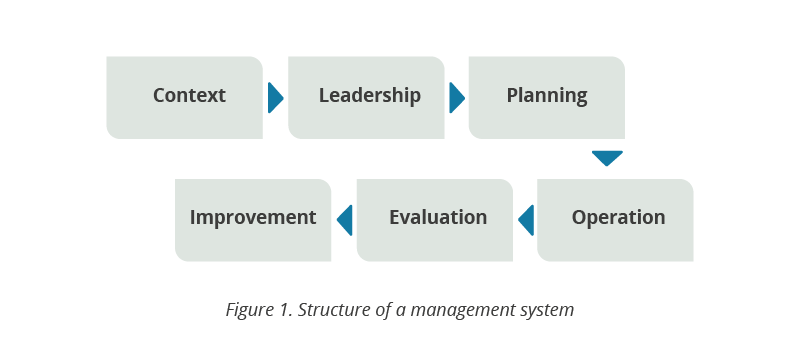
Once you have a clear grasp of the fundamentals, you can begin to understand how a food safety management system is structured (see Figure 1). From there, you will be able to identify how each standard or scheme develops these elements and what their differences are. This shifts your perspective from merely “knowing a standard” to truly understanding how a management system operates. This is where frameworks like ISO 22000, FSSC 22000, BRCGS, IFS, and SQF come into play. Just don’t make the mistake of thinking you need to study them all at the same time.
- Implementation
Knowledge must translate into the ability to execute. Knowing and interpreting a standard is entirely different from knowing how to put it into practice. Therefore, your next step should focus specifically on management system implementation. If you are just starting out, seek opportunities to get hands-on experience: review records, help update procedures, collaborate on a hazard analysis, investigate a deviation, or shadow more experienced colleagues. Every activity helps connect theory with reality. It is also crucial to learn from problems. A non-conformity doesn’t just mean something went wrong; it is an opportunity to ask what actually happened, what failed, and what the root cause was. This kind of analytical thinking helps develop strong professional judgment.
- Advanced Risk Management and Hazard Analysis
Delve into the technical side of the system. Once you have a general overview of how management systems work, it is highly recommended to dive deeper into hazard analysis and risk management. This training should cover: Hazard analysis methodologies, risk assessment, selection and validation of control measures, verification of controls, managing changes in processes and products, assessment of new hazards and reassessment of the hazard analysis plan. This stage is particularly critical because hazard analysis is the technical core of any food safety management system. An implementer must be able to understand why a specific control measure was chosen, what hazard it controls, and how its effectiveness can be proven.
Internal Audits and ISO 19011
Learn how to evaluate the system you have built. Even if your professional goal is to become an implementer, you still need to understand how a management system is audited. Training in internal audits provides vital knowledge on audit principles, planning, objective evidence, findings, non-conformities, corrective actions, follow-ups, and effectiveness evaluations. This training allows you to verify if the implemented processes are actually working and helps identify opportunities for improvement. Furthermore, it provides a solid foundation for understanding what your organization can expect during an official certification audit.
A solid career in food safety is built step by step. First, you understand the fundamentals; then, you learn how processes work and how hazards are controlled. The key is that each stage builds upon the previous one. True learning begins when you start asking yourself: What can go wrong? What could affect the food? How can it be prevented? How do we know the control is working? These questions will accompany you throughout your entire professional journey.
Autor: D. Peña.