How to make a market recall?

What’s a market recall? What’s the procedure suitable? In case of a recall, it’s important to have implemented two systems in our facilities.

Identification and tracking system

This system allows us to track and identify the raw material and packaging materials, which are in direct contact with the product at the facilities since we received them.

Products destination

To have established the destination where we are sending our products, once they come out of our facilities, warehouses, and operation areas. Once established the system, it’s important to monitor and examine its effectiveness. However, if we need to carry out a procedure to recall a product, we need to consider the following steps.

Market recall

1. To have information about contacts with who we will be communicating:

  • Internal contact: responsibilities or duties to operate a product recall.
  • External entity: to notify the product recall.

2. To inform the certifying body

To establish a direct contact with your certifying body to carry out a verification of a suitable recall.

3. To inform, local and sanitary authorities

Depending on the product or operation that could affect the market.

4. To notify the media

It’s important to designate a person within the committee to be responsible for communications. To inform about the points that will be provided. Periods when media will be handled.

5. Storage

Once we started the recall, we need to prepare the facilities to know where the product will be placed.

6. Damages follow up

Before destroying a product, we need to make sure, we have under control 100% of the deviated product. If this activity is not completed due to the product was purchased or consumed by a client, and the product is not recuperated, it’s important to properly follow up and know the damages to the consumer due to the product and compare it with the action plans. Also, when considering the business continuity, the product recall doesn’t end when we recuperate the product but after some subsequent actions.

7. Subsequent actions after the product recall:

  • Reasons for the deviation.
  • Actions to avoid recurrence, elsewhere?
  • How to increase the prestige of the business?

For further information and other topics, please contact us and a specialist will assist you www.globalstd.com

5 steps to handle nonconformances

According to ISO, a nonconformance is not fulfilling a system requirement, either specified or not. A requirement is a need or established expectation, usually explicit or mandatory.

First, you need to determine: what’s the contention or immediate action?

The purpose of this action is to stop the nonconformance occurrence and then analyze the root causes that provoke this nonconformance. Once determined the root cause(s), it shall be established corrective actions that attack each problem; otherwise, we could omit an activity or situation leading us to provoke a nonconformance. Afterword’s, once each action is made, some activities shall be determined to prevent nonconformance recurrence and most importantly, we shouldn’t confuse recurrence preventive actions and preventive actions, since they are different. This occurrence preventive actions will lead us to change formats and documents, and establish locks avoiding a nonconformance.

How to properly handle a nonconformance?

To determine contention or immediate actions can help us to find a root cause provoking a nonconformance.

Steps to follow:

  1. To determine the contention or immediate action.
  2. To stop nonconformances.
  3. To detect the root cause making a nonconformity.
  4. To establish corrective actions.
  5. To determine actions to prevent nonconformities.

Global Standards advice organizations setting methods of measuring and analysis to detect nonconformities, by using these methods and then establishing corrective actions the nonconformances minimize and then you can eliminate them.

The difference between an operational prerequisites and a program prerequisites

A common question among organizations when auditing: the difference between an operational and a program requirement?


The differences are highlighted among them, but the main one is that the operational prerequisites proceeds from hazard analysis and the pre-requirement program refer to the first protection layer creating a favorable environment when manufacturing food.


Some examples of a pre-requirement program are the following: Pest Control Good manufacturing practices program Maintenance Program Chemicals control program Allergens control program


The planned pre requirement programs depend on each organization’s needs. A pre requirement program of an organization producing food cannot be the same for an organization making packing material for the industry. The operational prerequisites come from hazard analysis and tend to be a control action without becoming a critical control point.


A specific example from the food industry is the risk of metal particles. In this case, a critical control point can be a metal detector, meanwhile the Operational Pre requirement a magnetic trap or a net existing during the flow. This means that the last step of the process is to eliminate or decrease risk as to its minimum.


The main difference between a Pre requirement program and operational program is that the operation prerequisites come from the hazard analysis as part of the process line, and the Pre requirement program enables a safe environment, assuring the produced product follows a safety method. In a few words, this is our first obstacle for controlling risks or hazards attached to the process.


HACCP guide

HACCP meaning:

Hazard Analysis and Critical Control Points. HACCP plan manages food safety by identifying, analyzing, and controlling physical, chemical, biologic and radiological hazards that could harm food. HACCP inspects raw material, the manufacturing stages, distribution, and finished product consumption.

Who can use HACCP?

The HACCP system applied to the industry focused on food production and for companies dedicated to produce inputs and materials in contact with food; as applicable to the pharmaceutical industry.


HACCP principles

  • Hazards
  • To identify
  • To limit
  • Corrective actions
  • To verify
  • To document


What are the benefits to implement a HACCP plan for your company?

5 important points for food safety

The food safety is a topic that shall concern us, although it’s not always like that, this information provided by the World Health Organization will help us to know the basic principles to prevent communicable diseases by mishandling food.


These simple points will help us to guard our family’s health and community by promoting hygiene practices in handling food.


1. To keep the cleanness
  • Wash your hands before preparing food
  • Wash your hands after using the bathroom
  • Wash and sanitize equipment and surfaces when preparing food.
  • Preserve food and kitchen areas from bugs, pets and other animals (keep food in closed containers).


Why shall we keep cleanness for complying with food safety?

There are hazardous microorganisms on the earth, water, animals, and people that could trigger food illness. These are carried by the hands, utensils, clothing, sponges and one other item not properly washed. A simple contact could contaminate food.


2. To separate raw and cooked food
  • To always separate raw, cooked and ready to eat food
  • To use the equipment and different utensils like knives or cutting boards to handle meat, chicken, fish and other raw food.
  • To keep food in a separated container to avoid contact between raw and cooked food.


Why shall we separate cooked and raw food?

Raw food, especially meat, chicken, fish, and their juices can be contaminated with a hazardous microorganism that could be transferred to food, while cooking or ready to eat meals, food preparation or store.


3. To completely cook food
  • To fully cook meat, chicken eggs, and fish.
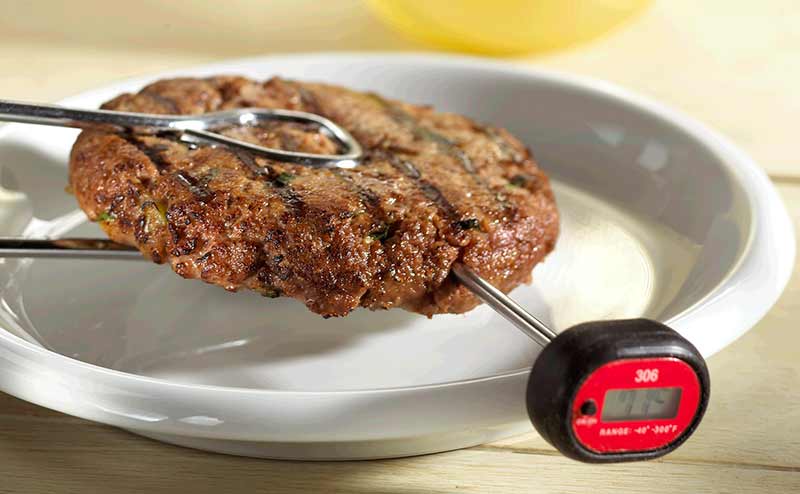
  • To boiled food like soup and stews at a right temperature of 158°F. When cooking meat and chicken make sure their juices are clear and not pink. We recommend the use of thermometers.
  • Overheat cooked food.


Why shall we completely cook food?

Proper cooking eliminates hazardous microorganisms. Studies show that cooking food at 158°F guarantees food safety for human consumption.

There is food like big chunks of meat, an entire chicken, ground meat required special boiling control.

Pre-heating eliminates microorganisms that could have developed during food preservation.


Termómetros para asegurar inocuidad de alimentos


4. To keep food at a proper temperature
  • Do not keep boiled food at room temperature for more than 2 hours.
  • Refrigerate boiled and perishable food (ideally under 41°F)
  • Keep warm food (above 140°F)
  • Do not keep food for a long time even if it’s inside a cooler. Keep ready-to-eat food for children.
  • Do not defrost food at room temperature.


Why shall we keep food at a safer temperature?

  • Some microorganisms can easily reproduce if food is kept at room temperature since they need food, humidity, temperature and time.
  • Microbial growth is slower, or it stops at below 41°F or above 140°F
  • Some pathogens could still grow at below 41°F.


5.- To use safer water and raw material
  • It’s safer to use treated water
  • For safety, chose processed food like pasteurized milk.
  • Wash fruit and legumes, especially if they’re eaten raw.
  • Do not use the food after the expiration date
  • Why shall we use safe raw material?


Why shall we keep food at a safe temperature?

Raw material, including water, can contain microorganisms but hazard chemicals. We shall be careful when choosing raw products and take preventive actions to wash and peel them which reduces the hazard.
We invite you to share with us your thoughts on these tips from the World Health Organization.


Source: World Health Organization


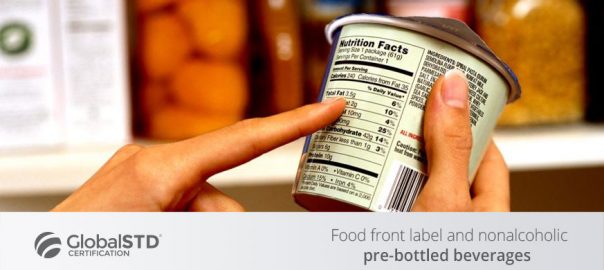
Food front label and nonalcoholic pre-bottled beverages

Last February 14th, 2014, was published on the Official Journal of the Federation, a decree which modifies and adds new dispositions of the Regulation of Sanitary Control of Products and Services. As a result of the decree, on April 14th, 2012 was published the guidelines referred to in article 25 of such regulation. For informative purposes, this shall be included in the frontal area of the exhibition.


The objective of the agreement establishes the criteria and specifications that food products and nonalcoholic beverages shall comply with the information requirements, which shall be displayed on the front label of the product; establishing a reference quantity of product presentation to be considered as single or family product.


Mexico has official standards that establish regulations for labels on food and nonalcoholic beverages, informing the consumer through labels with nutritionist value. The following standards are:


  • The Official Mexican Standard NOM-51-SCFI/SSA1-2010, general specifications on food labels and nonalcoholic pre-packaged beverages, commercial and sanitary information.
  • The Official Mexican Standard NOM-086-SSA1-1994, goods and services, altered food and nonalcoholic beverages, and Nutritional value.


However, the mandatory front label shall have the following information:


  1. State the calories on a product according to the recommended daily intake.
  2. Source distribution of calories in saturated fat, other fats, total sugars, and sodium.
  3. State the entire energy content of the product, portions, and calories.


In the case of saturated fats, other fats and total sugar shall indicate the energy intake of each nutrient, and the percentage of the product based on established values in the following chart:


Source of Energy Calculation basis
Saturated fat 200 calories
Other fats 400 calories
Total Sugars 360 calories
Sodium 200 milligrams


The information shall be displayed on food labels and nonalcoholic beverages mentioned in article 25 of the Sanitary Control Regulations of Products and services. It shall be placed in the front display area of the container so it’s noticeable, informational, and legible. The front display area is where the name and brand of the product is.


The mandatory reference to be displayed shall be in the following icon:


The minimum dimensions are regulated according to the front display area (for further information of the calculation, please check NOM-030-SCFI-2006), in this way the mandatory dimensions shall be at list of 0.5% for each reported icon but never less than 0.6 centimeters wide and 0.9 cm of height. In every case, each icon shall have two-thirds wide, concerning the height.


THE NOURISHMENT EXPRESSION AND ENERGY INTAKE SHALL BE UNDER THE FOLLOWING:


To comply with the following order from left to right.

The calorie intake shall represent the saturated fat, other fats, and total sugars using the abbreviation kcal and the percentage sign %.

You shall represent the sodium content in milligrams with the abbreviation of mg, g when it’s stating more than a million and percentage % sign.


You shall represent the energy word with the number of corresponding kilocalories and the abbreviation of kcal or cal.


The food and nonalcoholic beverages containers considered as single shall state the nutrition declaration and energy intake by the entire content.


In the event of portions, an image will be added to state the kilocalories per serving which will be placed at the end of the image from left to right. This shall indicate the number of portions per content under the last-mentioned image in the following way:


This amount won’t apply to:


  • Flavored beverages considered low-energy content.
  • A single packaged product, whose content is less than the portion indicated in article nine of the agreement.


In the event of a family pack where the product doesn’t have a declaration per serving, it shall comply with the following:


  • A declaration per serving, piece or homemade measured.
  • An image will be added to state the total kilocalories at the end of the icon, from left to right.
  • The number of portions content shall be indicated in the container, under the last-mentioned image.


The aim of the above is to inform the consumer about the entire energy intake if it’s consumed.


For further information regarding the corresponding calculation, exchange factors, size references of single or a family portion either measure or homemade units as well as the report; check the Agreement published in the Official Journal of the Federation dated on April 14th, 2014.


The National Strategy prevents and controls obesity. The obesity and diabetes specify that the food and nonalcoholic beverages labels shall inform the nutritional information to consumers and promote healthy decisions. The new front labels are a tool that the Federal Government uses to support this strategy. The challenge is to inform the consumer and make people think and analyze before purchasing a product, even though a product intake might be controversial.


 

ISO 26000 Guide | Socially Responsability

People familiar with ISO standards know that these standards positively contribute to solutions and benefits for almost all social sectors.

ISO 26000 background

In 2001, ISO studied the need to develop a standard of social responsibility. In 2004 a workgroup created ISO 26000 standard. This process has been so far the one with more participation, from six expert groups, interested parties, industry, workers, consumers, nongovernment organizations, service, support, investigation, and others.

In 2001, What’s ISO 26000?

ISO 26000 is an international standard providing a guide connecting social responsibility in an organization assisting organizations to support sustainable development. This standard is not a management system, neither certifiable. SA 8000 is the only certifiable standard by the International Social Accountability.

Social responsibility is defined by the commitment of an organization facing the consequences of decisions and activities upon the society and the environment through ethical and transparent behavior contributing to sustainable development, including the health and wellbeing of society.

This standard works together with other instruments and initiatives related to RS without replacing them: a guide for OCDE multinationals, Global Reporting Initiative, the United Nations Global Compact, among others.

ISO 2600 standard principles:

  • Accountability.
  • Transparency.
  • Ethical Behavior.
  • Respecting the interested party’s interests.
  • Respecting legality.

ISO 26000 establishes 7 fundamental topics of social responsibility that an organization shall address like the following:

  • Organization administration.
  • Human rights.
  • Work practices.
  • Environment.
  • Fair operating practices.
  • Consumer matters.
  • Active participation and community development.

ISO 26000 is a great tool for companies helping them to translate good intentions to actions, among other benefits, there’s the following: a greater competence, reputation, attract and retain employees, clients and users, stay motivated, commitment and productivity.

We are all part of this social responsibility chain, owners, managers, employees, and society; therefore, we are all responsible for its care. Policies and actions will be the letter of introduction to new generations who will have a good impression of the actions we did.

« 1 5 6 7