SQF Edition 9 Code Amendments

SQFI has introduced four code amendments to be implemented and audited with the applicable Edition 9 codes:


  1. Medical screening applies to Personnel Hygiene and Welfare, 3.3.1.1; 4.3.1.1; 9.3.1.1; 10.4.1.1; 11.3.1.1; 12.4.1.1; 13.3.1.1; 17.3.1.1. These elements shall include a medical screening procedure for all employees, visitors and contractors who handle exposed product or food contact surfaces.


  1. Approved Suppliers applies to 2.3.3 in the primary food safety codes and 2.3.4 in all other codes except Storage & Distribution. Approved supplier registers shall include supplier contact details.  All approved and emergency suppliers shall be registered.


  1. Multi-site program. Sub-sites within an SQF multi-site program can only operate in one or more of these food sector categories – 1, 2, 3, 4, 5, and 26.


  1. Application of Agricultural Chemicals. The requirements of 7.7.3.2, 5.7.3.2, 8.7.3.2, and 18.8.4.2 shall apply to the person(s) applying chemicals as well as the person making decisions on chemical application.


To those who upgrade to Edition 9. Should apply the following requirements:


  • 7.3.2
  • 7.3.2
  • 7.3.2
  • 8.4.2


The implementation date is October 4, 2021. All Edition 9 Code Amendments are available in the following link: https://www.sqfi.com/resource-center/edition-9-code-amendments

PrimusGFS Version 3.2 Documents

Azzule Systems has made its new version of PrimusGFS – v3.2 – currently available to auditees, it will be the mandatory version for audits scheduled after March 1, 2022.


PrimusGFS v3.2 aligns with the GFSI’s v2020.1 benchmarking requirements and offers both GAP (Farm, Indoor Agriculture, and Harvest Crew) and GMP (Cooling & Cold Storage, Packinghouse, Processing, Storage & Distribution) audits.


The GFSI scopes covered by the standard include:

  • Farming of Plants
  • Farming of Grains and Pulses
  • Pre-processing Handling of Plant Products
  • Processing of Plant Perishable Products
  • Processing of Animal and Plant Perishable Products (Mixed Products)
  • Processing of Ambient Stable Products
  • Provision of Storage and Distribution Services.


Version 3.2 brings updates to address:

  • The GFSI v2020.1 benchmarking requirements
  • stakeholder feedback
  • continued focus on FDA FSMA’s Produce Safety
  • Preventive Control for Human Food


As well as relevant recent best practice updates from commodity specific guidance documents, updates to GMP Applicability Charts, the addition of new corrective action closure requirements, updated scientific research metrics (e.g. mitigation buffer distances, produce wash water anti-microbial metrics), refined and improved GAP pesticide questions, and updates to question flow concerns where necessary (e.g., harvest practice questions).


All Version 3.2 Documents are available in the following link:

http://primusgfs.com/pgfs-v3-2/

ISO 22000:2018 – Food Safety Management Systems – Extra guidance on food safety

Keeping food safe involves the combined effort of every single player in the food production chain, from farm to fork. This means everyone needs to speak the same language and adhere to the same rules. ISO 22000 is an internationally recognized scheme in the food industry, and now a new guidance has just been published to help users get the most out of it. 


Published jointly by ISO and the United Nations Industrial Development Organization, the new handbook ISO 22000:2018 – Food safety management systems – A practical guide provides in-depth and practical information to help organizations more effectively implement a food safety management system (FSMS) in accordance with ISO 22000:2018.


Having such a system can bring enormous benefits to any organization involved in food production, as it can help to reduce the risk of contamination and harm to the end consumer. However, putting it in place is not always a simple task and can involves significant amount of time and effort.


This new handbook is designed to help the food sector prepare and implement an FSMS according to the ISO 22000:2018 requirements and guide them through the various tasks, thus making the process smoother and more effective.


ISO 22000:2018 – Food safety management systems – A practical guide also provides information about the certification process, which will be helpful to any organization seeking to obtain certification or wanting to learn about the ISO 22000 certification process. It is available for purchase from your national ISO member or the ISO Store.


References:

Extra guidance on food safety. (2021, March 9). ISO. https://www.iso.org/news/ref2639.html

The importance of prerequisite programs to implement HACCP

HACCP is a management system in which food safety is addressed through the analysis and control of biological, chemical, and physical hazards from raw material production, procurement and handling, to manufacturing, distribution, and consumption of the finished product. For the successful implementation of a HACCP plan, management must be strongly committed to the HACCP concept. A firm commitment to HACCP by top management provides company employees with a sense of the importance of producing safe food.


HACCP is designed for use in all segments of the food industry from growing, harvesting, processing, manufacturing, distributing, and merchandising to preparing food for consumption. Prerequisite programs such as Good Manufacturing Practices (GMPs) are an essential foundation for the development and implementation of successful HACCP plans. Food safety systems based on the HACCP principles have been successfully applied in food processing plants, retail food stores, and food service operations. The seven principles of HACCP have been universally accepted by government agencies, trade associations and the food industry around the world.


Prerequisite Programs


The production of safe food products requires that the HACCP system to be built upon a solid foundation of prerequisite programs. Each segment of the food industry must provide the conditions necessary to protect food while it is under their control. This has traditionally been accomplished through the application of GMPs. These conditions and practices are now considered to be prerequisite to the development and implementation of effective HACCP plans.


Prerequisite programs provide the basic environmental and operating conditions that are necessary to produce safe, wholesome food. Many of the conditions and practices are specified in federal, state, and local regulations and guidelines (e.g., GMPs and Food Code). The Codex Alimentarius General Principles of Food Hygiene describe the basic conditions and practices expected for foods intended for international trade. In addition to the requirements specified in the regulations, the industry often adopts policies and procedures that are specific to their operations. Many of these are proprietary. While prerequisite programs may impact upon the safety of a food, they also are concerned with ensuring that foods are wholesome and suitable for consumption. HACCP plans are narrower in scope, being limited to ensuring food is safe to consume.


The existence and effectiveness of prerequisite programs should be assessed during the design and implementation of each HACCP plan. All prerequisite programs should be documented and regularly audited. Prerequisite programs are established and managed separately from the HACCP plan. Certain aspects, however, of a prerequisite program may be incorporated into a HACCP plan. For example, many establishments have preventive maintenance procedures for processing equipment to avoid unexpected equipment failure and loss of production. During the development of a HACCP plan, the HACCP team may decide that the routine maintenance and calibration of an oven should be included in the plan as an activity of verification. This would further ensure that all the food in the oven is cooked to the minimum internal temperature that is necessary for food safety.


For a successful HACCP program to be properly implemented, management must be committed to a HACCP approach. A commitment by management will indicate an awareness of the benefits and costs of HACCP and include education and training of employees. Benefits, in addition to enhanced assurance of food safety, are better use of resources and timely response to problems. Before developing and implementing an effective HACCP plan, prerequisites and training need to be established first.


Many of the conditions and practices are specified in federal and provincial regulations and guidelines. All prerequisite programs should be documented and regularly audited and are established and maintained separately from the HACCP plan.


References:

Center for Food Safety and Applied Nutrition. (2017, December 19). HACCP Principles & Application Guidelines. U.S. Food and Drug Administration. https://www.fda.gov/food/hazard-analysis-critical-control-point-haccp/haccp-principles-application-guidelines

Scott, V. N., & Stevenson, K. E., PhD. (2006). HACCP, a Systematic Approach to Food Safety (4th ed.). FPA Food Products Association.


ISO SURVEY RESULTS 2018

Every year, the International Organization for Standardization (ISO) introduced an ISO Survey showing an overall view of ISO standards certification for management systems.

According to the 2019 survey results, the total number of valid certificates was less than 2017; the reason is associated with the involvement of certification bodies and changes in data, provided by the same organizations, generating an important reduction of recorded certificates.

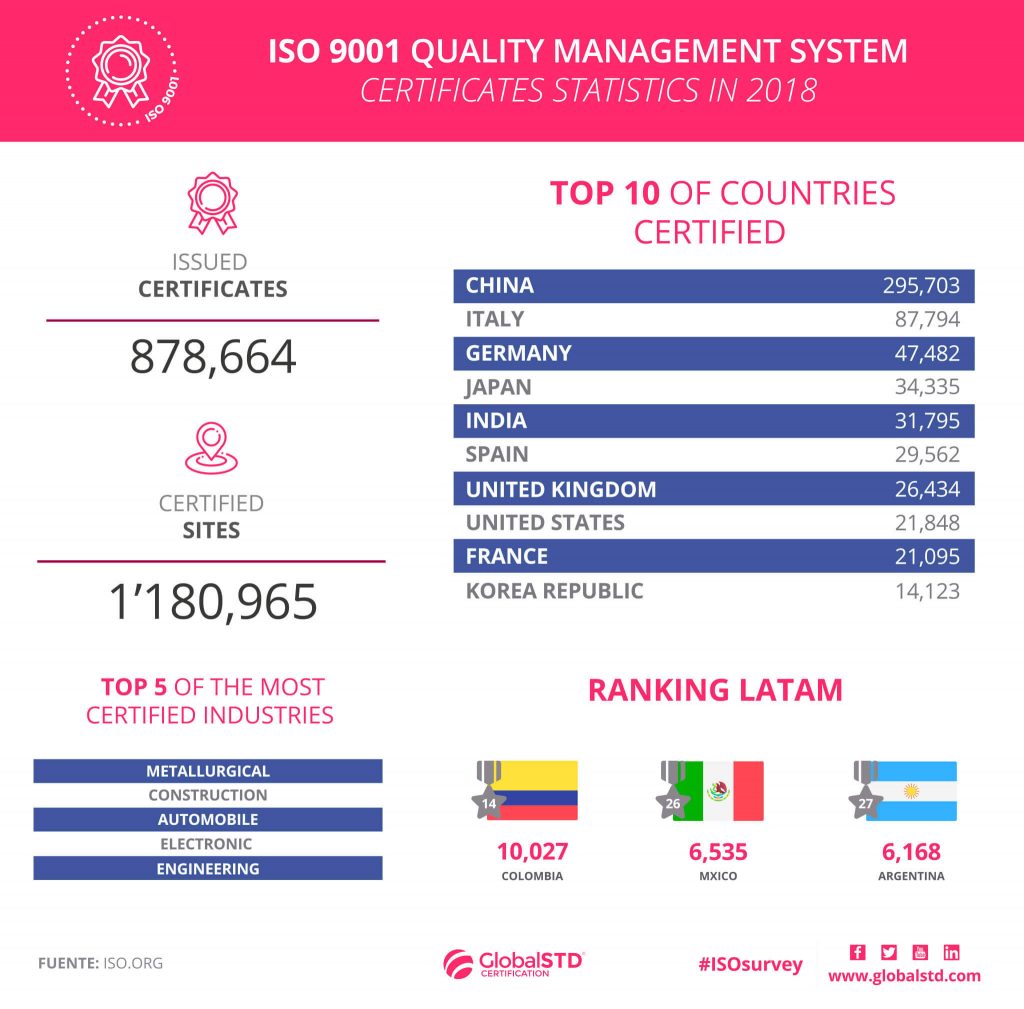
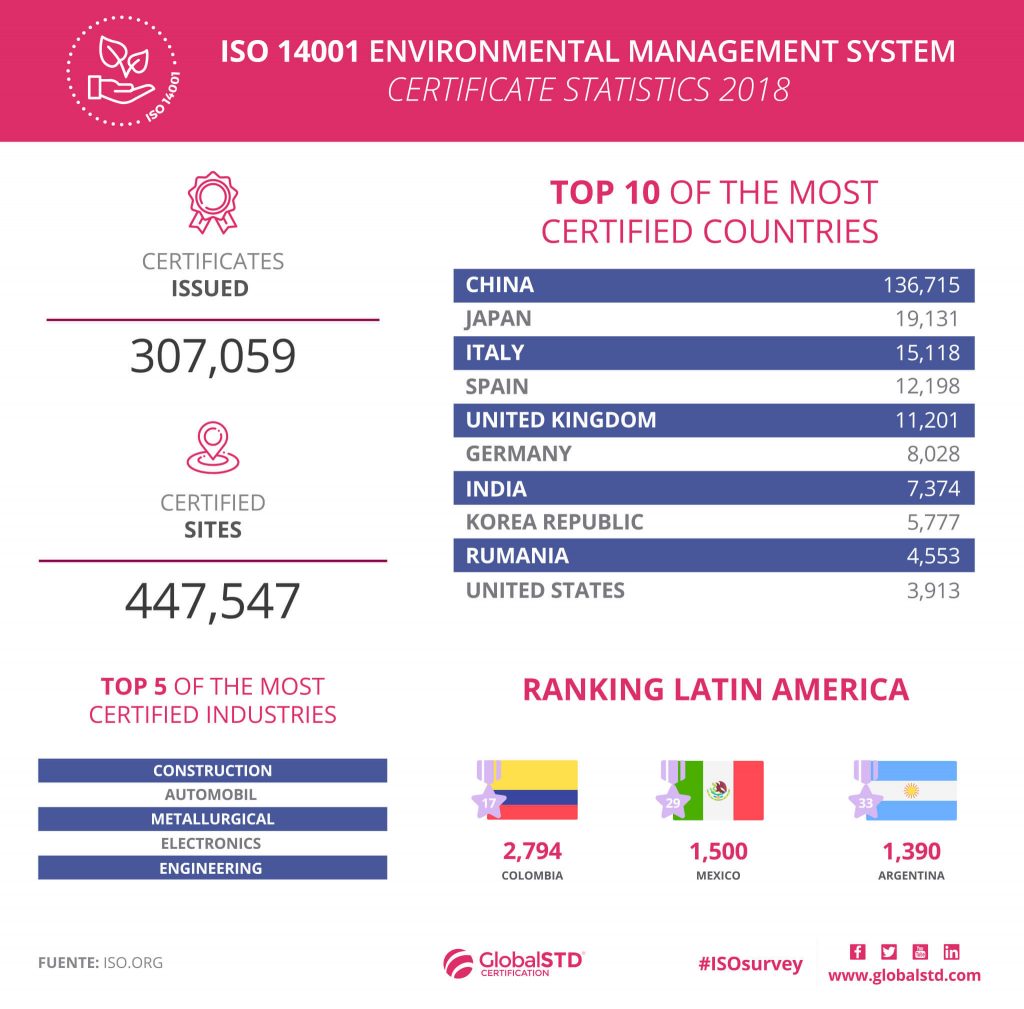
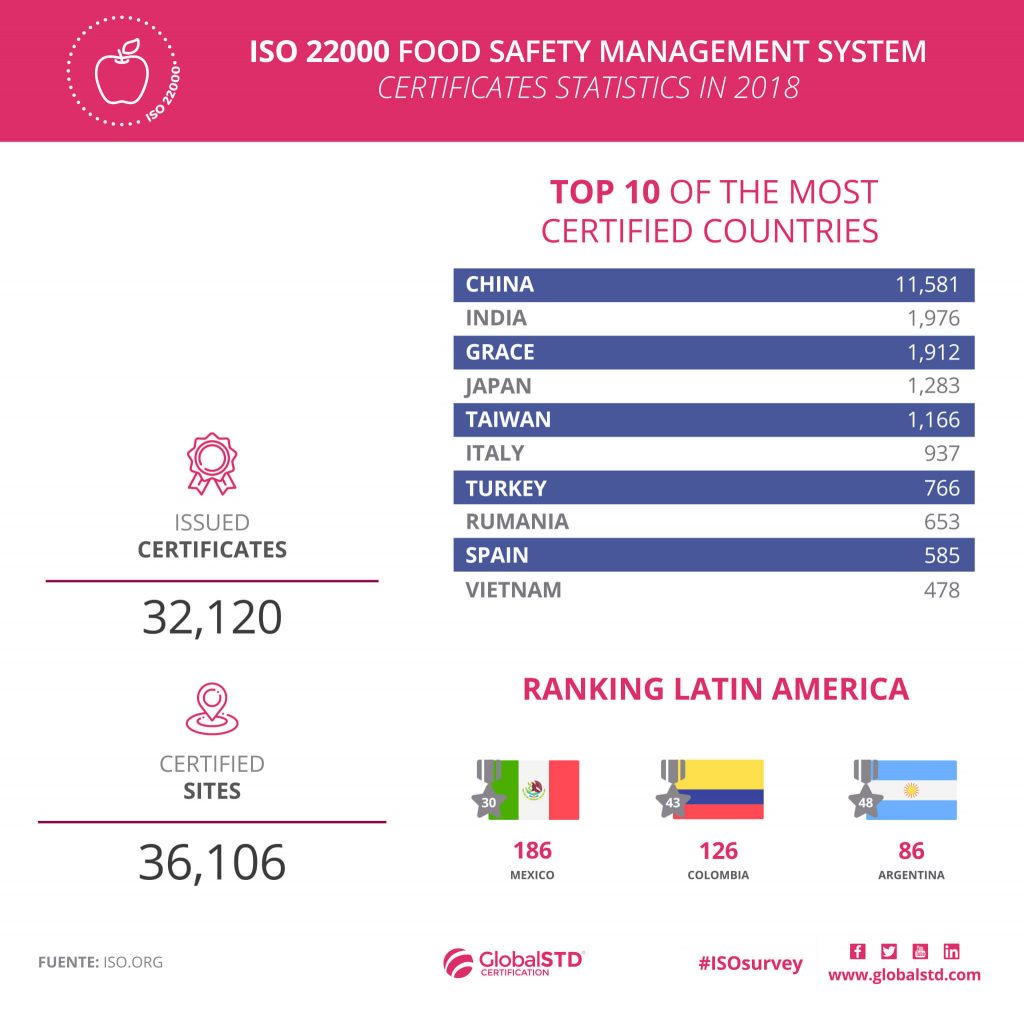
The following chart exposes the total number of valid certificates and several sites per standard, presented by ISO 2018 Survey.

Standard Certificate number Sites number
ISO 9001:2015 878,664 1’ 180,965
ISO 14001:2015 307,059 447,547
ISO IEC 27001:2013 31,910 59,934
ISO 22000:2005&2018 32,120 36,105
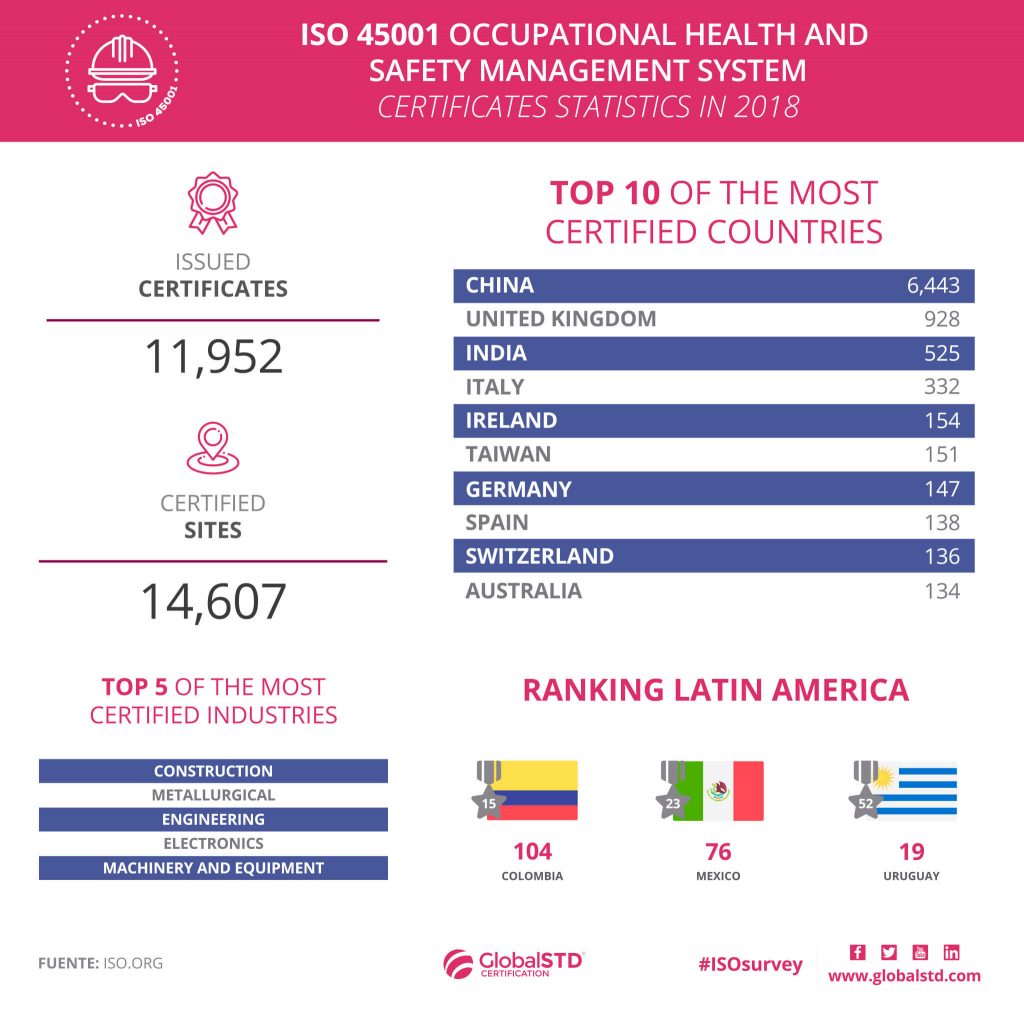
ISO 45001:2018 11,952 14,607
ISO 13485:2003&2016 19,472 24,123
ISO 50001:2011 18,059 46,770
ISO 20000-1:2011 1,506 5,282
ISO 28000:2007 617 666
ISO 39001:2012 547 1,422
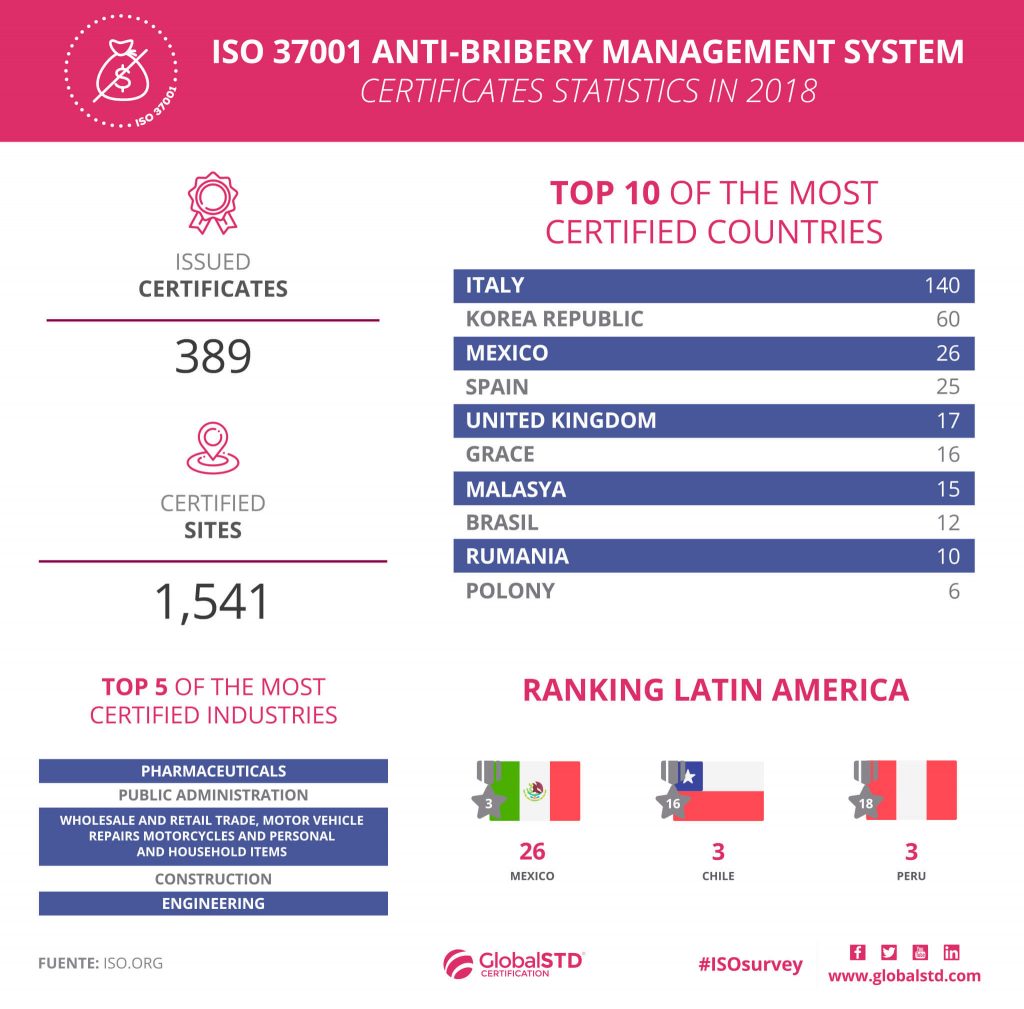
ISO 37001:2016 389 1,541

Next, we have the main international standards, countries, and industries with the higher number of certificates.

ISO 9001

ISO 14001

ISO 22000

ISO 45001

ISO 27001

ISO 37001

The 7th regulations of FSMA

President Obama in 2011 signed FMSA, a work regulation set that changed the American Food Safety Systems for more than 70 years. The FDA published seven major regulations under FSMA, each one establishes new requirements creating responsibility in the industry to prevent pollution of food suppliers, instead of reacting to these issues.

*FSMA regulations do not cover the meat, birds, and processed eggs, these are regulated by the United States Department of Agriculture (USDA).

To whom applies this regulation?

The regulation acknowledges the links of the production chain and food supply that will be inspected for complying with the FSMA regulations. From the producer to those related to the production process, transformation, transport, and distribution affecting the animal or human consumption products.

Regulations

FSMA has added 7 new regulations focused on preventing and reacting to possible food safety matters involving companies in the United States and abroad.

Regulation  Proposal  Final (consent decree)
Preventive control (food for humans) January 16th 2013 August 30th 2015
Preventive controls (animal food) October 29th 2019 August 30th, 2015
Fresh products January 16th 2013 October 31st 2015
Verification Program of Foreign Supplier July 29th 2013 October 31st, 2015
Third Parties Accreditation July 29th 2013 October 31st 2015
Sanitary transportation February 5th 2014 March 31st 2016
International adulteration December 24th 2013 May 31st, 2016

Preventive Analysis and Risk Control for Human Food Consumption

Request establishments under this regulation to have a written plan about food safety, preventive analysis, and controls for identified risks. Reviews and updates regulations on Good Production Practices (CGMP,) including allergens protection, and cross-contamination and updates the content of these activities.

The Fresh Field Safety Regulations/PSR

The regulations establish standards in the following areas:

  • Employee training, health, and hygiene.
  • Agricultural water uses.
  • Soil with biological improvements of animal origin.
  • Domestic animals and wild animals.
  • Production, harvest, handling and packaging activities.
  • Equipment, tools, and constructions.
  • Germinate.

If this regulation does not comply, the food is considered an adulterer and rejected.

Third-party auditors and certifiers accreditation regulation

It establishes eligibility requirements for accreditation bodies or outsourced auditors, to be acknowledged by the FDA. An accreditation body may be a government office or a private third party (like the government or a foreign company). The accreditation bodies and third-party auditors shall comply with certain standards, like have the legal authorization, competition, capacity, impartiality, objectiveness, quality assurance, and procedure recording.

The Preventive Animal Feed Controls (HARPCA)

The goal here is to prevent issues with animal food. Establishments are required to comply with Updated Good Production Practices (cGMPs) implementing preventive controls for identified risks.

Including establishments that manufacture, process, packs and handles animal food under FSA registration, and the Bioterrorism regulation. Also, the cGMPs were established for the first time for businesses that manufacture, process, packs, and handle animal food. A food safety plan shall have a written document on the risk’s analysis, preventive controls, and preventive control guidelines, and frequent application; also, a written document on corrective procedures, verification procedure, a retirement plan, and a supply program.

A Foreign Supplier Verification Program (FSVP)

The importer shall develop some specific fundamental activities for verifying risks in each imported food produced, providing the same level of security requested by the American producers and complying with adulterer requirements and mislabeling established in the PSR, HAPC, and FDCA.

The importer handling food establishments under any verification disposition of suppliers, including preventive control regulations shall consider complying with FSPV regulations.

* A qualified individual shall develop and apply this program.

The program content includes:

  1. A food risk analysis for each food the importer imports.
  2. A supplier’s verification to control identified risks.
  3. Corrective actions managing complaints.
  4. Periodic evaluation of the FSVP.
  5. Importers identification.
  6. A logbook for each performed activity.

Regulations for sanitary delivery of humans and animals’ food

Serves to guarantee a safe delivery from any type of risks, the goal for this regulation is:

  • Not complying with suitable food refrigeration.
  • Cleaning vehicles in between loading.
  • Not complying with proper protection when delivering food.

This secures a hygienic delivery for:

  • Shippers
  • Carrier
  • Recipient

It covers food and animal feed.

* This regulation is based on the updated practices of food safety delivery.

Regulation for protecting food against unintentional adulteration

The owner, operator or head agent of an establishment, under this regulation, shall prepare or implement a food defense plan which shall include:

  • Identifying an actionable process step.
  • Targeting mitigation strategies.
  • Monitoring procedure.
  • Corrective Actions.
  • Verification.

Factors affecting FSMA compliance

  • Integrating the operation productive chain of exportation.
  • The adoption level of SRRC in the company.
  • Type of product.
  • The level of innovation of the company.
  • The material uses in the production process.
  • The risk level of the product.

ISO 21001:2018 for Educational Organizations 

Talking about education and after time, there’s been a big effort to provide education with good quality, evolving in infrastructure, equipment, staff competence, new programs and ways to study aiming to follow one mission: to improve our society.

Regarding the regulations, some institutions have fulfilled their challenges and transformed their goals, based on tools that allow them to keep and improve a teaching technique, besides using other technologies and research; basic tools to achieve this, like a certification and quality management system, however, with this evolution, a new standard was released to finalized the efforts, ISO 21001:2018 “educational institutions”, this standard will assist in monitoring these important concepts and ensuring the teaching process, learning or research.


THE STANDARD STRUCTURE

Complies with the High-Level Structure (HLS) allowing to adapt to educational institutions that already have a management system.

  1. Application field and aim
  2. Regulatory references
  3. Terms and definitions
  4. The organization context

4.1 The organization context and comprehension

4.2. Needs and expectations comprehension by the interested parties

4.3. Scope determination of the management system for educational organizations

4.4. Management system for educational organizations (SGOE).

  1. Leadership

5.1. Leadership and commitment

5.2. Policy

5.3. Organization position, responsibilities and authorities

  1. Planning

6.1. Measures to handle risks and opportunities

6.2. Objectives for educational organizations and planning to achieve.

6.3. Planning changes

  1. Support

7.1. Resources

7.2. Competence

7.3. Awareness and training

7.4. Communication

7.5. documented information

  1. Operation.

8.1. Planning and operations control

8.2. Products and educational services requirements

8.3. Products and educational services design and development

8.4. process control, products, and externally provided services

8.5. The provision of products and educational services.

8.6. Products and educational services delivery

8.7. Control of non-compliant educational outings

  1. Development evaluation

9.1. surveillance, measurement, analysis and evaluation

9.2. Internal audit

9.3. Management review

  1. Improvement

10.1. Corrective action and non-compliance

10.2. continual improvement

10.3. improvement opportunities

Annex A. additional requirements for children’s educational organizations

Annex B. Principles of educational organizations management system (SGOE)

Annex C. interested party’s classification of educational organizations.

Annex D. guidelines for interested party’s communication

Annex E. Process, actions, and tools in educational organizations

Annex F. Mapping example to regional standards

Annex G. Health and Safety considerations for educational organizations

                                                          ISO MODEL

                                                         PDCA CYCLE

Important points to consider:

ISO 21001, specifies the requirements for a management system for educational organizations (SGOE) when such organization, when that organization:

  • To demonstrate the capacity to support the competencies development and acquisition through teaching, learning, and investigation.
  • The aim is to improve the student’s satisfaction with other beneficiaries and staff through the effective application of SGOE, including the process improvement to the system and assure the compliance with students’ requirements and another beneficiary.

ISO 21001 requirements are universal and claim to apply at any organization that uses a study plan supporting the development of competence, through teaching-learning or researching, no matter the type, size or delivery method.

ISO 21001:2018 may apply for educational institutions in bigger organizations whose main business is not the education, for example, the professional training department.


NOTE: ISO 21001 does not apply to organizations that manufacture or produce educational outputs. 

It’s important for those educational institutions that already been certified or have a management system to implement, keep and improve their teaching method, through this new standard, ensuring the teaching method by learning or researching


ISO and High-Level Structure (HLS)

Throughout the years, ISO has published several standards for Environmental and Quality Management System with common elements, but with different structures. Companies that had implemented several standards in their management system face a challenge, which is finding a way to best integrate and combine standards until ISO developed an SL annex.

SL annex created by ISO, it’s the new structure for a generic management system, it has a structure for the new and reviewed management system standards. ISO’s annex target is that auditors of the management system use a basic set of generic requirements in all disciplines and industrial sectors, also implement one that reduces conflicts, duplication, confusion, and misunderstanding because of different structures handling different standards.

The ISO initiative will apply to all management system standards, public and technical access specifications (TS). Moreover, new versions of ISO 9001:2015, ISO 14001:20015, based on the SL annex higher-level structure. Also applicable for ISO 450001, about the management of occupational safety and health systems.

The implementation advantages of a higher-level structure in companies will be noticeable, the main one is to implement a new way, where companies will work on templates and shall be adopted to the specific needs to normalize the management system. To achieve it, the responsible leaders of the implementation could help by using a simple tool; to conduct a general framework of the management system through which could differentiate the common management requirements and specific management standards.

What is that you need to know about the higher-level structure?

1. Some concepts of the higher-level structure which stand out:

  • Risk
  • Interested parties
  • Documented information

In this case, the risk is thought as a preventive action concept evolution. From the interested parties, it shall be considered when analyzing the organization context. Lastly, the documented information, documents and system records are gathered, even though the management system procedures aren’t mandatory.

2. The common structure of requirements sections, it’s as follows:

Chapter 4. Organization context.

Chapter 5. Leadership.

Chapter 6. Planning.

Chapter 8. Operations.

Chapter 9. Performance evaluation.

Chapter 10. improvement. Orientation annex

3. The fact that the management standards have a structure, texts and vocabulary in common, you could add new requirements, additional subclauses or new vocabulary.

To conclude, we will say that the higher-level structure provides a common approach for new and future managements system, also increases the benefits for administrators of standards, auditors, companies and organizations. The higher-level structure allows companies to visualize the implementation of several management systems working simultaneously, representing strong added value, before the competitive market.

FOOD FRAUD

Food fraud is deceiving to obtaining a benefit from food. There are different types of food fraud, like the following:


  • Ingredients: by adding, substituting and adjusting; forgery of any ingredient to reduce cot or improve a feature.
  • A false or misleading statement: to state a benefit or feature or origin in a label that’s not included.


Fraud is a criminal activity due to financial motivations, as organizations, we shall prepare control measures enabling us to reduce impact when we’re involved in a fraud.


To deem food fraud vulnerability, we consider 3 factors: opportunities, motivations, and not suitable or none control actions, which we could illustrate as follows:


Opportunities + motivations-control measures

= vulnerability


Opportunities:

You shall consider if your product passes through a big sales chain, in which some incidence may occur, as a control action, we shall purchase from known distributors or brand representatives who have better handling.


Motivations:

If the product is on-trend due to origin, composition, characteristics and high demand. You shall guarantee the supply chain controls of the product. Any probable lucrative motivator could be presented.


Control actions:

Actions were taken to control opportunities and motives that may be presented within the supply chain, like the following:


  • Raw material supplier’s analysis certificate;
  • Supplier’s raw material (and an identity analysis);
  • Supply chain audits;
  • Safety and policy seals of raw material input and output;
  • Better processes for approving suppliers;
  • A balance test of mass carried out at the supplier’s facilities of raw material and adulterated products;
  • Supply chain changes, for example, a supplier or shorter change;


After adding up the most motivating opportunities, fewer control measures, we will find the vulnerability.


The vulnerability is different for each raw material since each one goes through a different process and control. To constantly review the official pages about a product recall, it could help to determine if control actions are suitable or if something must change to reanalyze the product. Let’s consider buying products from origin or authorized distributor will give us a guarantee, to conduct supplier’s audits and even an identity analysis of raw material to ensure that the product is as specified.


Therefore, we will try to minimize future vulnerability, when we prepare food and straighten the supplies chain.


ISO 9004 and its services in companies

Privately or publicly, there are many companies in our countries with a quality management system implemented under ISO 9001 requirements that bet on to achieve trust, security and business excellence.

A quality management system requires an evaluation regarding the client’s perception, this allows companies to know if the quality is perceived internally and externally. One difficulty that companies face is that ISO 9001 does not establishes processes that shall be identified, since ISO does not standardize the approach when following the processes. To solve this and other obstacles, the organizations could study ISO 9004.

ISO 9004, “the management for an ongoing success” provides instructions to achieve ongoing success, through an approach based on quality management. This standard is an example for companies that could self-evaluate their level of maturity, leadership terms, strategies, process and resources and obtain a clearer and complete vision of quality, looking forward to the next step.

ISO 9001 and 9004 have a close relation, the first one focuses on requirements, so the company implements a quality management system; meanwhile, the second version fulfills the first one by providing ideas to carry it out at the organization; without considering the performed activity. ISO 9004 also has an entire chapter about the ongoing success (something not added in 9001), as well as a chapter of financial resources and participation and motivation of people that work in the company.

The 9004 standards do not have a certification, meaning there’s no sense of strict follow-up, only allows interested organizations shall improve the quality and services of the products by promoting a self-evaluation system.

The new ISO 9004 version is on the review process and waiting to be published in 2018. The objective of this renewal is to adapt to the present and future needs of companies and market changes. The revision is carried out by a working group ISO/TC 176/SC under the BSI secretary, United Kingdom.

According to Nigel Croft, a president of ISO/TC176/SC 2 committee, the new edition will be based on improving the last version orientation 2009; this will help the organizations to go beyond ISO 9001 standards, talking about the alignment and deployment of the strategy, the policy and objectives within the context to a wider vision, mission, values and culture of the organization.

ISO 9004 is recommended for any type of company, either public or private, independently the size of the sector; also, this standard is totally integrated to other management systems, like environmental, health and safety at work, among others.